The Real State of AI Adoption in 2026 (What the Data Actually Shows)
8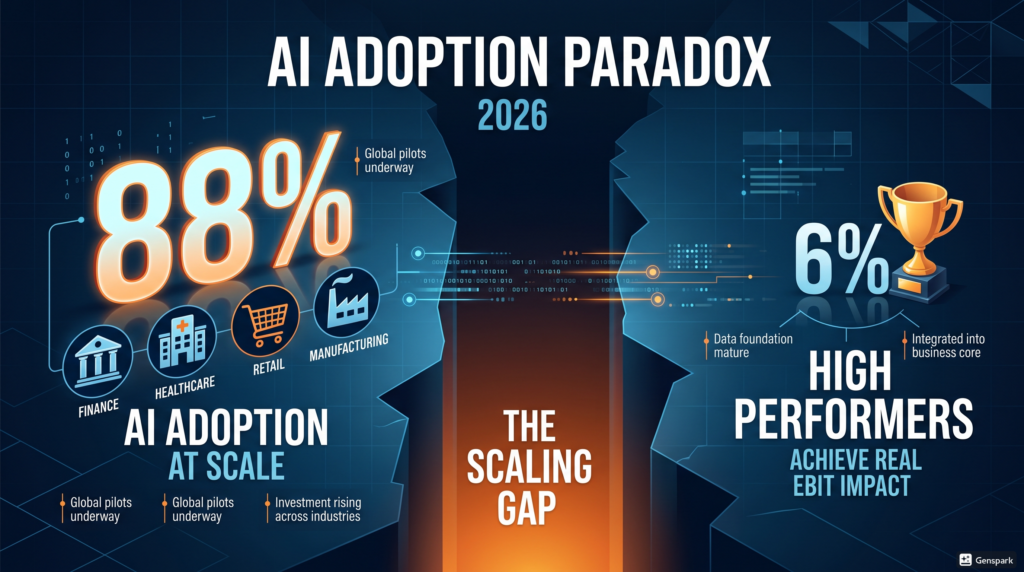
Most people consuming AI content in 2026 still start from a dangerous premise: that nearly every company is already making real money with artificial intelligence.
The data shows a very different reality.
According to McKinsey’s global State of AI 2025 survey, 88% of organizations report regular use of AI in at least one business function. That number rose from 78% the previous year. At first glance, it looks like a total AI victory.
Looking more closely, the picture changes.
Nearly two-thirds of organizations have not yet begun scaling AI across the company. Only about one-third have started any meaningful scaling. Even more revealing: just 39% of respondents say AI has generated any measurable impact on EBIT (earnings before interest and taxes). And among those 39%, the majority report that the impact represents less than 5% of total EBIT.
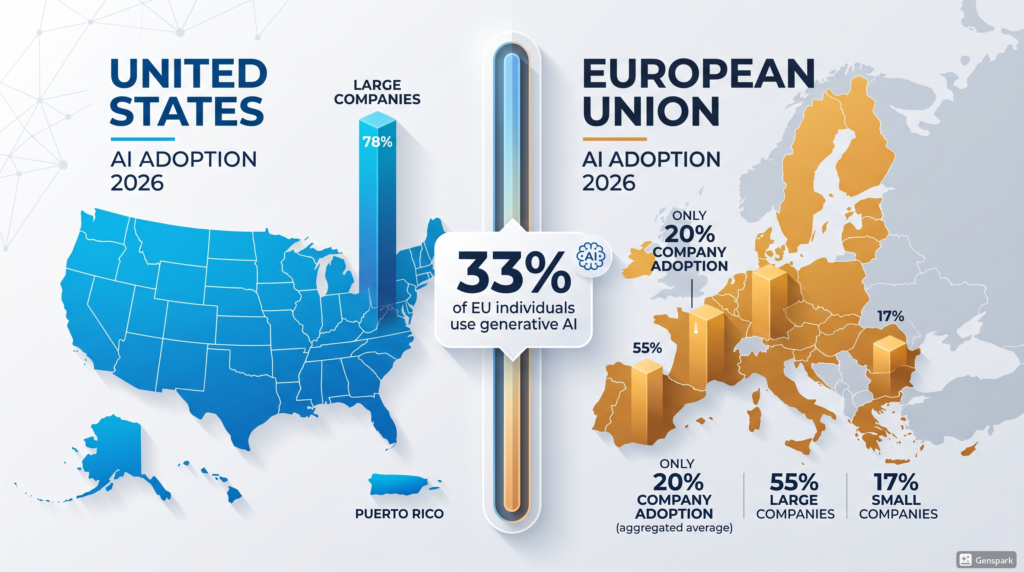
In Europe the gap is even wider. Eurostat data from 2025 shows that only about 20% of companies in the European Union with 10 or more employees used any AI technology. Among large companies the figure reaches 55%, but among small ones it sits at just 17%. Generative AI use among individuals reached 33% in the EU, yet real adoption inside companies continues to lag well behind the United States.
This is the actual 2026 landscape:
- Adoption is widespread.
- Scaling is still rare.
- Measurable financial impact remains limited for most organizations.
For freelancers, consultants, and solopreneurs in the U.S. and Europe, this gap is not a problem — it is the opportunity. Companies bought tools and ran pilots. Many still do not know how to turn those experiments into consistent results.
That is exactly the opening we will explore throughout this series.
The market is not saturated with successful AI implementations. It is full of organizations that started but have not finished. Understanding this completely changes how you position any AI-related service or product.
Why Most AI Side Hustles Fail (And What the Data Reveals About the Real Obstacles)
If you tried launching an AI side hustle in the last two years and felt stuck, know that you are not alone — and the problem is not you.
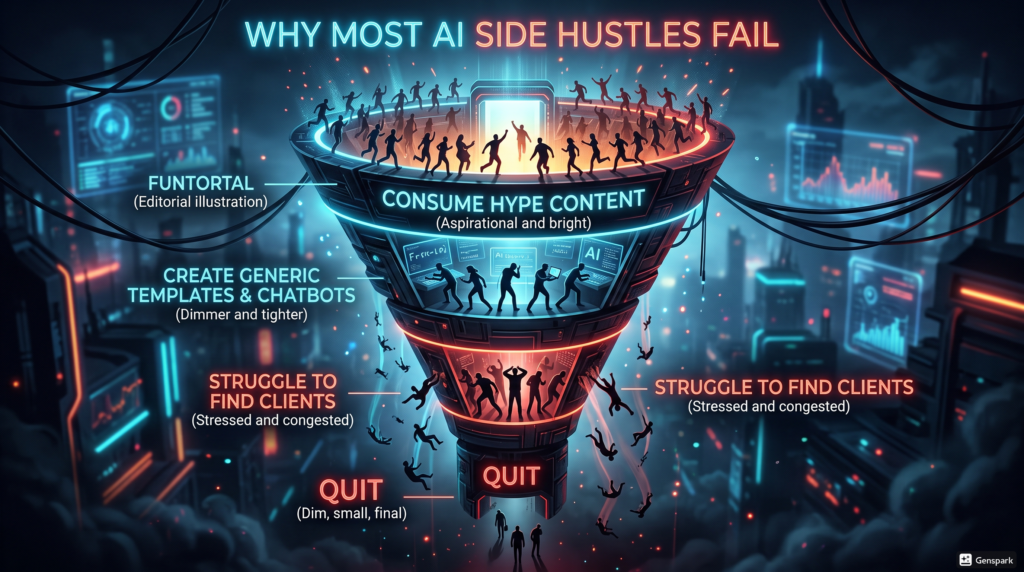
The most common failure pattern among American and European creators and freelancers follows a predictable sequence:
- They consume content promising quick income with AI tools.
- They start creating generic content, templates, or simple chatbots.
- They struggle to find paying clients or sustainable traffic.
- They conclude that “AI side hustles don’t work” and quit.
The data helps explain why this happens so often.
McKinsey’s research shows that while 88% of organizations use AI, the majority remain stuck in the experimentation or pilot phase. Only a small share (around 6% in some analyses of the same dataset) qualifies as “high performers” — those generating significant EBIT impact (5% or more). This means the market is flooded with tools and experiments, but very few companies are achieving clear, repeatable results.
At the same time, Upwork’s In-Demand Skills 2026 report shows that demand for skills explicitly tied to AI grew 109% year over year. The fastest-growing categories were not generic content creation. They were:
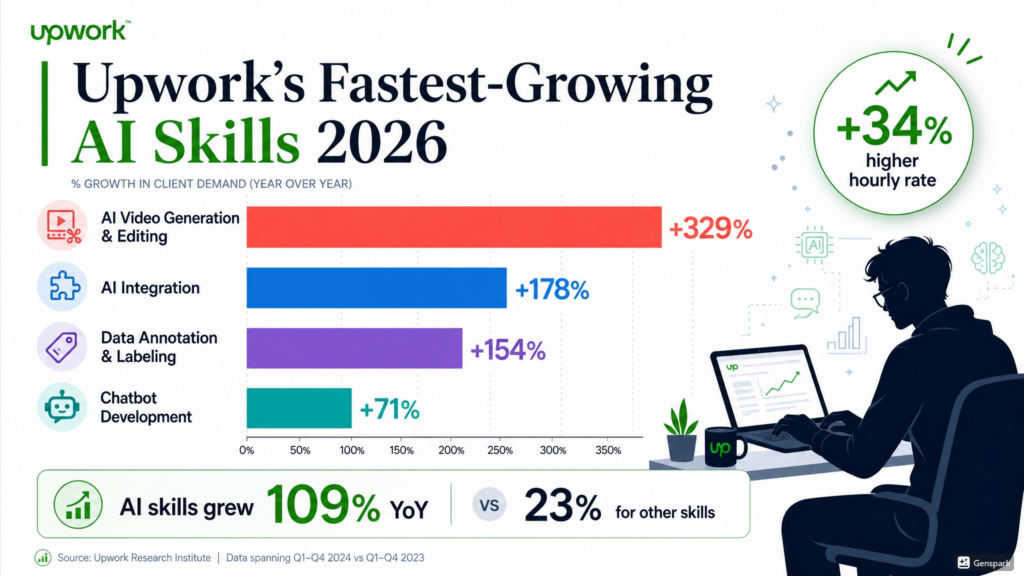
- AI video generation and editing (+329%)
- AI integration (+178%)
- Data annotation and labeling (+154%)
- Chatbot development (+71%)
Notice the pattern: the strongest demand is for people who can apply AI inside real workflows, not for those who simply generate more content or sell prompts.
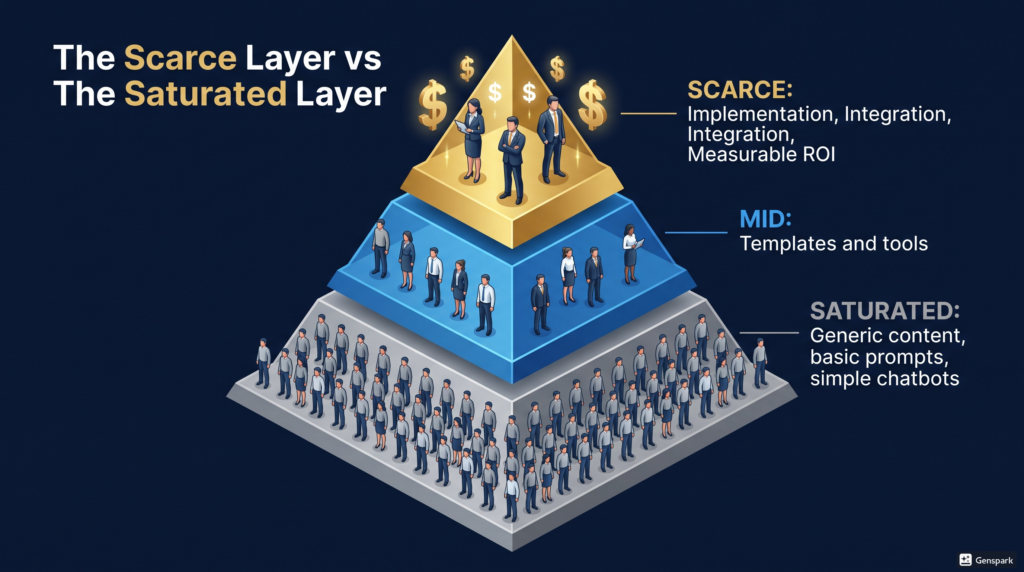
Most side hustles that fail compete in the saturated layer (generic output) instead of operating in the scarce layer (implementation, integration, and measurable improvement).
Specific friction points in the American and European markets:
- In the U.S., competition is high and clients are increasingly sophisticated about what “powered by AI” actually means.
- In Europe, lower enterprise adoption (Eurostat) means many small and medium-sized businesses still need basic help, but they are also more cautious about budget and compliance (especially with the AI Act).
The result is a classic mismatch: lots of people offering what is easy to produce, and few people offering what companies actually need to move from pilot to production.
Most AI side hustles fail because they compete in the crowded layer of content and simple tools instead of operating in the scarce layer of implementation and measurable business results. The data shows clear demand — it just isn’t where most people are looking.
Where the Real Demand Is in 2026 (McKinsey and Upwork Data)
If Parts 1 and 2 showed the gap, Part 3 shows exactly where the money and demand are concentrated.
Two primary sources give us a clear picture:
From McKinsey (State of AI 2025): Organizations are actively seeking help to move beyond pilots. The biggest barriers are not access to models — they are strategy, operating model, talent, data, and adoption practices. Companies that define clear KPIs for their AI solutions and redesign workflows around the technology are the ones that start seeing real impact.
From Upwork (In-Demand Skills 2026): Skills that explicitly mention AI grew 109% year over year (versus only 23% growth for other in-demand skills). Freelancers doing AI-related work already earn, on average, 34% more per hour than those who do not use AI. The strongest growth is in applied skills:
- AI video generation and editing
- AI integration into existing systems
- Data annotation and labeling
- Chatbot and agent development
What this means in practice for someone in the U.S. or Europe:
The strongest opportunities in 2026 sit at the intersection of three things:
- Domain knowledge (understanding a specific industry or business process)
- Ability to implement or integrate AI tools
- Ability to show measurable improvement (time saved, cost reduced, conversion increased, etc.)
The generic pitch “I write content with AI” or “I build a basic chatbot” no longer differentiates anyone. What differentiates is: “I help [specific type of business] turn an AI pilot into a system that actually reduces support tickets by X% or improves response time by Y hours.”
That is why service-based models (automation for local businesses, implementation consulting, specialized content systems with human oversight) are currently outperforming pure products or templates for most independent operators.
Real demand in 2026 is concentrated in applied AI work — helping organizations cross the gap from pilot to production. Data from both McKinsey and Upwork point in the same direction: implementation and measurable business results beat generic AI output.
These three parts form the solid foundation of the series. They align expectations, explain the real problem, and point to where the opportunity sits, without creating unnecessary frustration for the reader.
AI Automation and Agents for Local Businesses (The Most Accessible and Recurring Path)

This is currently one of the paths with the best balance between entry difficulty and potential for recurring revenue for freelancers and solopreneurs in the US and Europe.
The logic is simple: most local businesses (clinics, workshops, real estate agencies, restaurants, service providers) still operate with manual and overloaded processes. They buy AI tools, run a pilot, and then get stuck. That’s exactly where someone who knows how to implement steps in.
Example that worked A well-documented 2025/2026 case involved a regional HVAC (heating, ventilation, and air conditioning) company in the United States with 12 employees and about 400 calls per month. They implemented AI-powered call handling and triage automation.
Results:
- Significant time savings for the team
- Calculated ROI of approximately 595%
- Payback in just a few days
Source: Case study published in small business automation analyses (ai-crescent.com and similar 2026 reports).
Another positive example is Rachio (a smart irrigation company). They used AI agents from Crescendo.ai to handle seasonal spikes in technical support. The system absorbed a large volume of complex questions without increasing headcount at the same rate.
Why it worked:
- Very specific and measurable problem (call/support volume)
- Integration with the real workflow (not a generic standalone chatbot)
- Clear success metrics from the start
Example that went wrong The most famous failure in automated customer service is Air Canada’s. The company’s chatbot gave a passenger incorrect information about its refund policy. The company tried to claim it wasn’t responsible, but a Canadian court ruled that Air Canada was liable for the information provided by the bot. The company had to pay the difference.
Another well-known failure was McDonald’s AI drive-thru experiment in partnership with IBM. After testing in more than 100 locations, the project was shut down because customers grew frustrated with order comprehension errors. Complaint videos spread across social media.
Why it failed:
- Lack of adequate human supervision
- The system didn’t handle exceptions and accents well
- No clear escalation process to a human when the AI failed
Practical lesson: Anyone selling automation to local businesses needs to focus on narrow problems with clear metrics and always leave a human handoff option. Generic projects (“we build chatbots for any company”) tend to fail. Specific projects (“we reduce real estate lead response time by X hours”) have a much higher chance of success and of turning into recurring revenue.
Quality Content with Human Oversight (Still in Demand, But the Form Has Changed)

Many AI content side hustles died because people tried to sell “100% AI-generated articles.” The market (especially mid-sized companies in the US and Europe) rejected that quickly.
What still works is a different model: use AI for speed + humans for quality, brand voice, and strategy.
Example that worked The SEO agency House of Growth managed to double its article volume (from 80 to 160 per month) without increasing team size. They used AI for drafts and well-defined prompt templates, but kept rigorous human review for brand tone and quality.
Results:
- Savings of more than 85 hours per month
- Production increase with no noticeable loss in quality
Source: Case study shared in analyses of AI use in content operations (2025/2026).
Companies like Duolingo also demonstrated the value of the combination: they used GitHub Copilot as a “force multiplier” for developers while keeping human control over architecture and final quality.
Example that went wrong Several publishers and content sites tried to scale production 100% with AI between 2024 and 2025. Many suffered organic traffic drops after Google updates and lost reader trust. The problem wasn’t only the technical quality of the text—it was the lack of originality, real experience, and a human point of view.
Another common failure pattern: freelancers who delivered “ready” AI-generated texts without deep review. Clients noticed the generic pattern and canceled.
Why the human-oversight model still works: Because McKinsey and other studies show that most organizations still keep humans in the loop, especially when content represents the brand or influences buying decisions. AI accelerates. Humans ensure relevance, accuracy, and differentiation.
Practical lesson: If you’re going to work with content, don’t sell “AI articles.” Sell a “content production system that combines AI speed with strategic human review.” The positioning completely changes the perceived value.
AI Implementation Consulting (The Highest-Value Path)

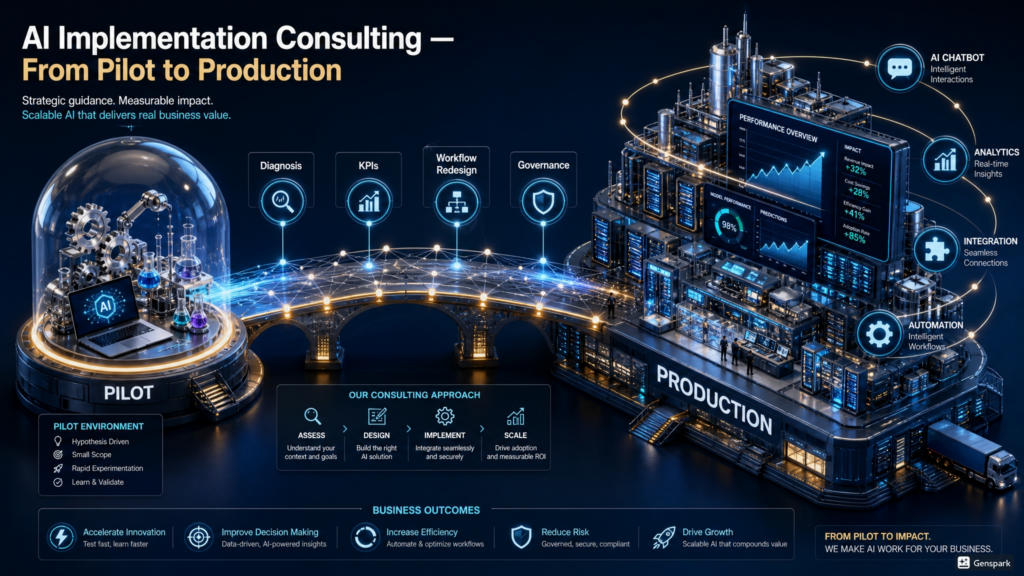
This is the path with the highest potential for ticket size and differentiation, but it also requires more maturity. The big pain point for companies in 2026 (confirmed by McKinsey) is exactly the difficulty of moving from pilot to production with measurable results. Reports like the one from the MIT Media Lab have pointed out that about 95% of AI pilots in companies do not generate measurable returns.
Successful example Several independent consultants and small specialized consultancies have had success helping mid-sized companies redesign processes before scaling AI. A common success pattern is to start with a clear diagnosis of “where AI really generates impact in this specific business” instead of arriving by selling a tool. Companies that define clear KPIs from the start and redesign the workflow (and not just “put AI on top of the old process”) are the ones that appear in McKinsey’s success cases.
Example that went wrong In addition to the Air Canada and McDonald’s cases already mentioned, there are dozens of examples of companies that invested hundreds of thousands (or millions) in AI projects that never left the pilot stage. A recurring pattern is the lack of an internal project owner, absence of clear metrics, and attempts to solve problems that are too vague (“we want to be more innovative with AI”). Microsoft’s Tay chatbot (even though it’s from previous years) continues to be cited as a classic example of lack of basic protections and adversarial testing.
Why does well-done consulting work? Because the scarcity is not in tools. It’s in people who can:
- Diagnose the real business problem
- Choose the use case with the highest chance of ROI
- Design the process + the technology together
- Define metrics and governance from the start
Practical lesson: Anyone entering this path needs to sell diagnosis + implementation + follow-up, and not just “I set up tool X for you.” The value is in reducing the risk of the client becoming part of the 95% who see no return.
AI-Powered Digital Products and Newsletters (Realistic Expectations)
This is the path that most attracts people who dream of more passive income. It is also the one that generates the most frustration when expectations are wrong.
Digital products (templates, prompt packs, mini-courses, simple tools) and newsletters can work well in 2026, but they rarely start generating thousands of dollars per month. The most common pattern among those who achieve consistent results is:
- Start small and validate real demand
- Use AI to accelerate production
- Build an audience before relying solely on cold traffic
The creator economy continues to grow (projections point to values above US$ 200 billion), and most creators already use some form of AI in their workflow. However, saturation of generic products is high. What still stands out are products that solve a specific problem for a specific audience, with some layer of experience or human point of view.
Newsletters follow the same logic. Platforms like Beehiiv make monetization via ads and sponsorships easier, but growth to a base that actually pays (generally above 8–10 thousand engaged subscribers) takes time. Those who treat the newsletter as a long-term asset, and not as a quick shortcut, tend to do better.
When is it worth following this path? When you already have (or are willing to build) an audience or your own distribution. Without that, most digital products depend too heavily on ads or ranking on Google/Etsy/Gumroad, which has become more competitive.
Digital products and newsletters can generate interesting income, but they are almost never the fastest path to the first results. They work better as a second or third move, after you have already validated some type of service or authority.
How to Choose Your Path and Validate It in 30 Days
After learning about the main paths (automation for local businesses, content with human supervision, implementation consulting, and digital products), the most important question is: which one makes the most sense for you right now?
A practical way to decide is to look at three factors:
- Your current knowledge Do you already understand a particular industry or business process? (real estate, healthcare, e-commerce, local services, etc.). The more domain knowledge you have, the easier it will be to position yourself in automation or consulting.
- Your tolerance for talking to people Automation and consulting require conversations with clients. Content and digital products allow for more solitary work at the beginning.
- Your time-frame goal If you need faster traction, services tend to convert better in the short term. If you can invest more time in building an asset, products and newsletters gain strength.
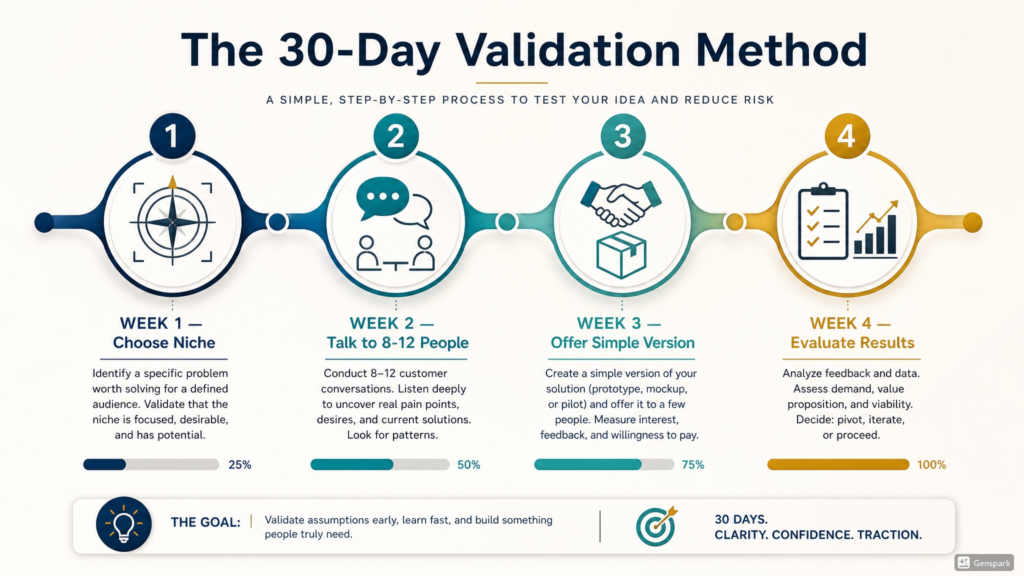
Simple 30-day validation method:
- Week 1: Choose one path and a very specific niche.
- Week 2: Talk to 8–12 people from your target audience (without trying to sell). The goal is to understand the real pain.
- Week 3: Offer a simple and inexpensive version of your service or product to 2–3 people (even if it’s almost free).
- Week 4: Evaluate what happened. Was there real interest? Did people understand the value? Did you enjoy executing it?
This short process prevents you from spending months building something nobody wants.
Sources such as the Upwork report (In-Demand Skills 2026) and McKinsey data on the difficulty of scaling reinforce the same idea: those who validate quickly and focus on real business problems have a better chance of finding demand.
Main conclusion of Part 8: Do not choose the path based on what looks “easiest” or most “scalable” on paper. Choose based on what you can validate with real conversations in 30 days.
The First 90 Days: What Really Matters
Many people freeze after understanding the theory. This section is the practical execution plan.
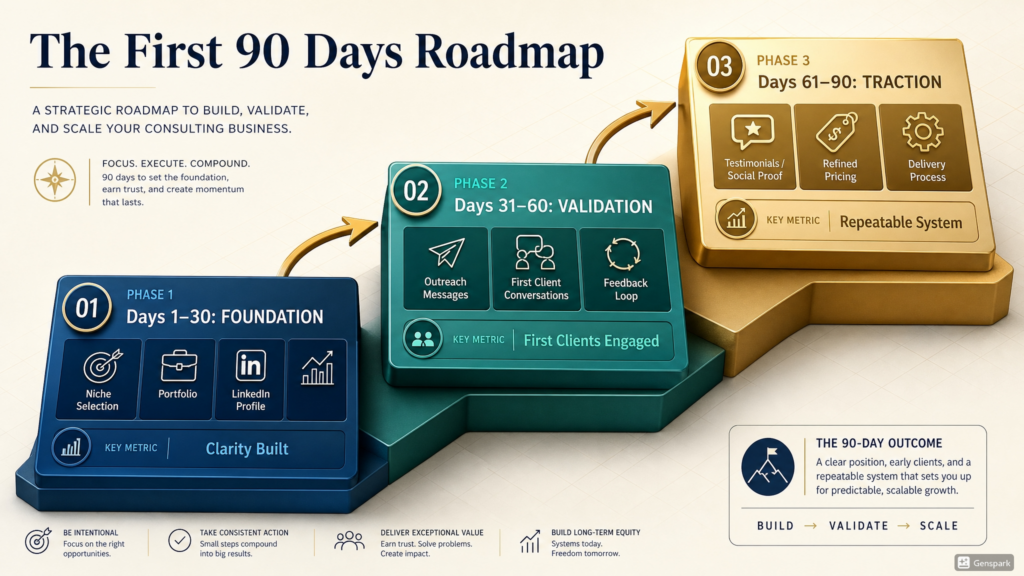
Phase 1 – Days 1 to 30 (Foundation)
- Choose a single path and a specific niche.
- Define the offer clearly (what you deliver + the result the client can expect).
- Build a minimum portfolio (even if they are personal projects or well-documented pro bono work).
- Create a simple professional profile (LinkedIn + basic page or portfolio).
Phase 2 – Days 31 to 60 (Validation and first contacts)
- Do direct outreach and conversations (LinkedIn, groups, referrals, communities in your niche).
- Offer the initial version of the service to the first clients, even at a reduced price.
- Collect detailed feedback and adjust the offer.
- Start documenting results (even if small).
Phase 3 – Days 61 to 90 (Initial traction)
- Turn the first results into social proof.
- Adjust the price to a more sustainable level.
- Create a minimum delivery process so you don’t get overloaded.
- Decide whether to keep going deeper on the same path or start testing a second move (for example, turning the service into a digital product).
The most common mistake during this period is trying to do several things at the same time or abandoning the chosen path at the first difficulty. Market data shows that demand exists, but it responds better to those who show up consistently and solve a concrete problem.
Main conclusion: The first 90 days do not need to generate high income. They need to generate clarity, social proof, and a process you can repeat. Income comes as a consequence.
Mistakes That Kill Your AI Side Hustle + How to Measure Real Progress
We have reached the final part of this series. So far we have seen the reality of the data, the paths that actually have demand, and a practical 90-day plan. Now we will talk about what most often takes down those who are starting: the silent mistakes and the wrong way of measuring progress.
The mistakes that most destroy AI side hustles in 2026
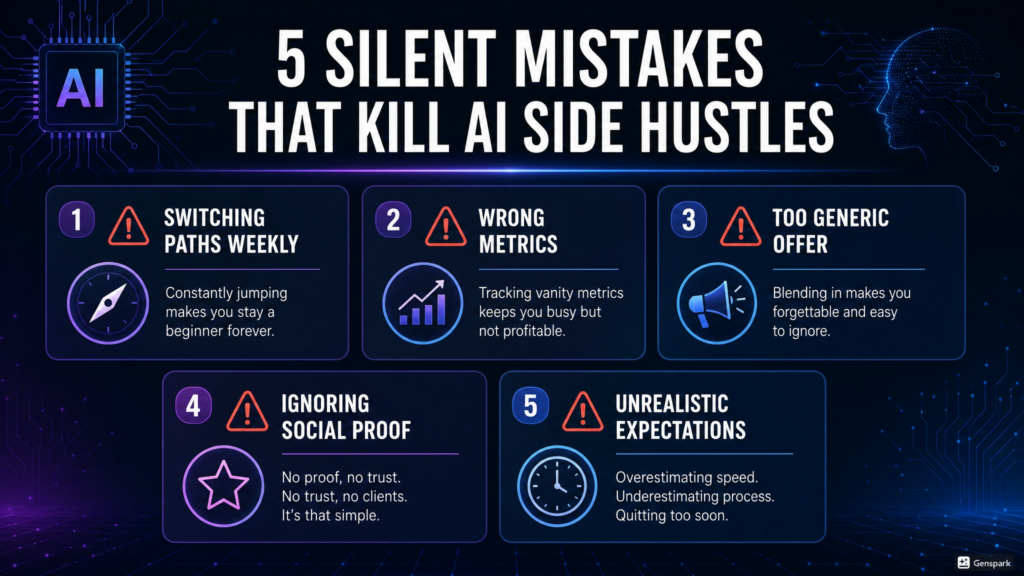
- Switching paths every week The person tests automation, then content, then digital products, then consulting. They never stay long enough on a single path to generate social proof or learn what actually works. Market data (Upwork and McKinsey) shows that demand exists, but it responds to consistency and specialization, not to dispersion.
- Measuring the wrong metrics Many people track only “how many posts I made,” “how many templates I created,” or “how many contacts I sent.” These are activity metrics, not real progress. What matters is: how many genuinely interested conversations did you have? How many people said “this solves a problem I have”? How many first jobs (even cheap or pro bono) were you able to deliver?
- Offering something too generic “I create content with AI” or “I automate processes with AI” is a weak offer. Companies and local businesses respond much better to specific proposals: “I help dental clinics reduce response time for new patients” or “I implement an automatic follow-up system for real estate agencies.”
- Ignoring social proof at the beginning Even if the first jobs are cheap or almost free, documenting the before and after (time saved, leads answered faster, content published with more consistency) creates the most valuable asset of the first months.
- Expecting results that are too high too fast McKinsey data shows that most organizations are still stuck between pilot and scaling. This means demand exists, but the sales and trust cycle is usually longer than motivational content suggests. Those who quit in month 2 or 3 were often on the right path—they just did not have the patience for the real cycle.
How to measure real progress (metrics that matter)
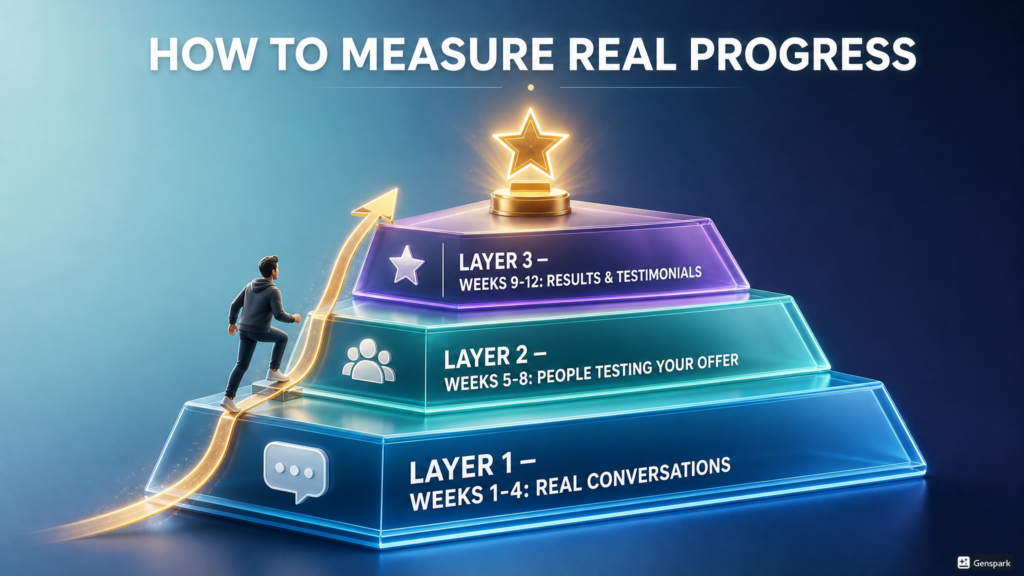
Instead of relying on vanity, use these three measurement layers:
- Layer 1 (Weeks 1-4): Number of real conversations with the target audience and quality of the feedback received.
- Layer 2 (Weeks 5-8): Number of people who agreed to test your offer (even at a low price or pro bono).
- Layer 3 (Weeks 9-12): Results delivered + testimonials or concrete metrics you can show.
If these three layers are advancing, you are on the right path—even if income is still low. If none of them is moving, the problem is not “the AI market,” but positioning or execution.
Final summary of the series
- AI adoption is high, but scaling and financial impact are still limited (McKinsey).
- Real demand is in implementation and measurable results, not in generic output (Upwork).
- The most solid paths today are: automation for local businesses, content with human supervision, and implementation consulting.
- Digital products and newsletters work better as a second move.
- Fast validation + 90-day consistency + the right metrics make more difference than any tool.
Recommended next post: In the next article we will solve exactly the biggest difficulty that appears after this series: “How to get the first 3 AI service clients in 2026 (without spending on ads and without looking desperate)”
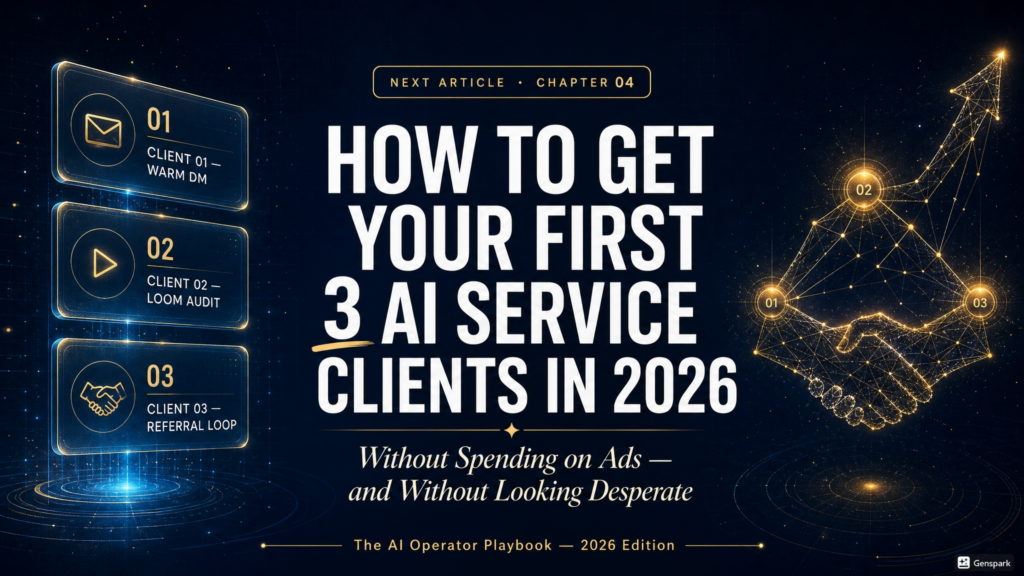
There you will find a practical outreach method, examples of messages that work better, how to turn conversations into first jobs, and what to avoid so you don’t burn your image at the beginning.
This next post is the natural complement to this series: it takes the clarity you already have and turns it into concrete commercial action.