2026 AI Tools Comparison: Best Platforms for Scaling Marketplaces & Affiliate Businesses (With Real ROI Data)
1The AI tools landscape in 2026 has reached structural maturation, moving beyond speculative volatility to deliver measurable business outcomes for marketplace operators and affiliate marketers. This comparison evaluates leading platforms using real ROI data, critical analysis of both positive and negative impacts, and their genuine contribution to workforce productivity and societal progress across multiple sectors.
Executive Summary: Top Platforms by Use Case
Real ROI Data from Verified Implementations
Marketing & Content Creation
- 30–40% improvement in campaign performance for companies using AI in marketing
- 25–50% reduction in time on repetitive tasks
- 5–8x return on AI tool investment within the first year
- 150–200% organic traffic increases from AI SEO
- 35–50% CPA reductions from AI advertising
Specific Business Cases
Affiliate Marketing ROI Examples
- GoHighLevel: 1,084% ROI (conversion rate 18% vs. 8% email-only)
- Rankability: 3,287% ROI ($4,200/month revenue from $124/month tool)
- General ROI: 604% average for AI affiliate tools
Critical Positive Analysis
✅ Strengths & Success Scenarios
1. Productivity Revolution
- Average business implementing basic AI automation reports 30–40% reduction in administrative overhead within six months
- AI increases productivity and GDP by 1.5% by 2035, nearly 3% by 2055
- 3–5x content output increases without quality degradation
2. Healthcare Transformation
- AI agents enhance human workforce rather than replacing doctors
- Early detection of diseases through AI-interpreted radiographic imaging
- Personalized healthcare and accelerated drug discoveries
3. Education Personalization
- Adaptive learning platforms and AI tutors personalize education unprecedentedly
- Shift from standardization toward deeper understanding and individual growth
- Tools support lifelong learning and skill development
4. Successful Company Implementations
- Gamma: Hit $100M revenue with just 50 people
- BBVA: Embedded AI into daily operations with Custom GPTs at scale
- L’Oréal: Boosted creative output through CREAITECH and Adobe Firefly
- CMA CGM: Deployed MAIA internal assistant powered by Mistral AI
Critical Negative Analysis
❌ Limitations & Failure Scenarios
1. AI Affiliate Site Death Pattern
- 91% of affiliate sites using AI are failing because they become content farms
- Sites die after 3–6 months due to Google’s 2026 algorithm crushing AI-generated content
- Topical authority mistake kills 90% of new affiliate sites
- Amazon and affiliate networks are cracking down on AI content
2. Measurement & Attribution Breakdown
- When consumers get answers inside chatbots rather than clicking publisher links, attribution mechanisms break
- 27.3% fold affiliate into general performance bucket; 14.8% don’t represent it at all in MMM
- 70.6% haven’t run geo-split tests or incrementality lift studies
3. Data Infrastructure Gaps
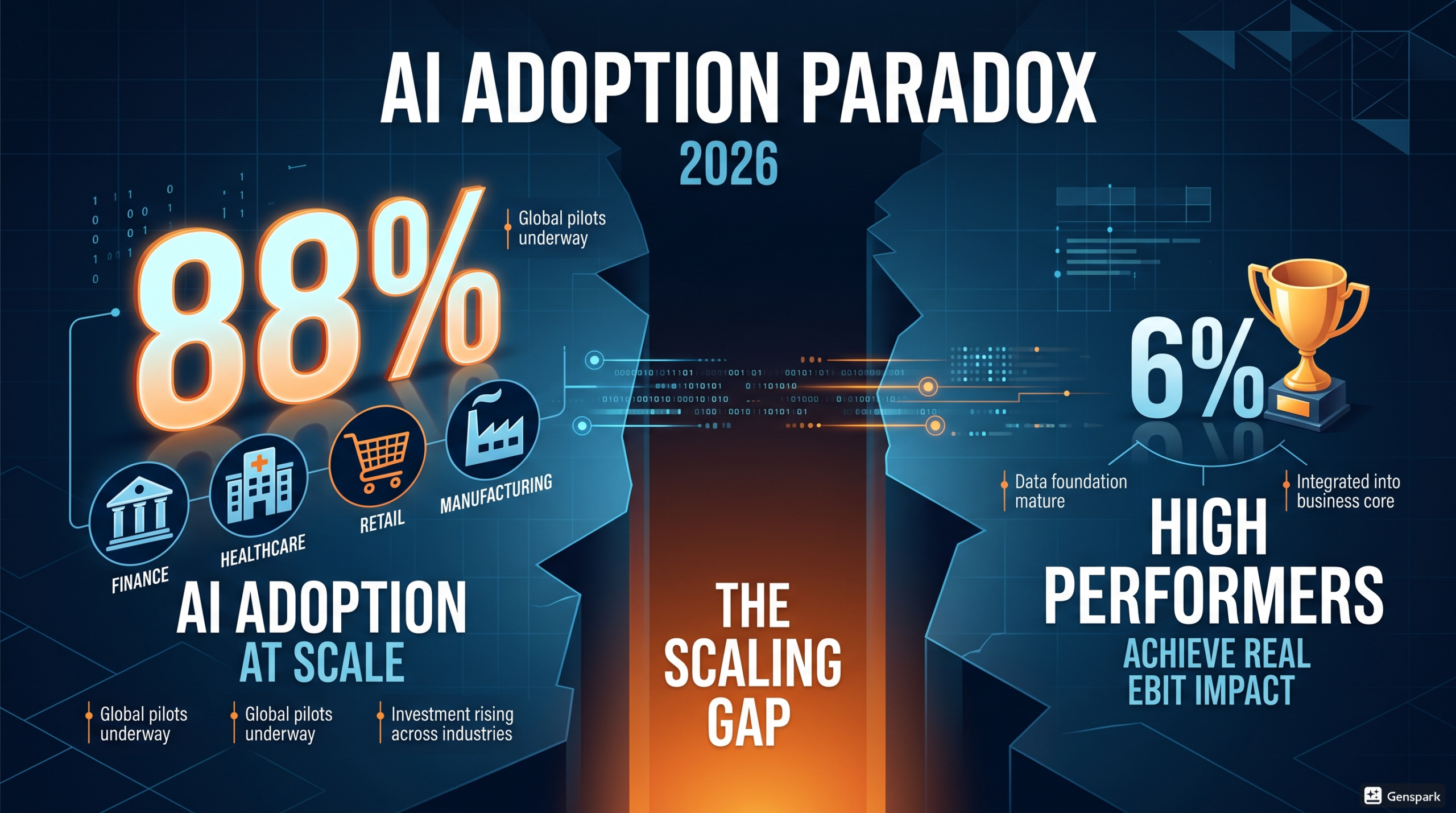
- Poor data quality and fragmented infrastructure remain biggest barriers to AI scaling
- Only 21% of AI pilots ever make it to real production scale
- Inference costs, bloated prompts, and orchestration overhead can turn each interaction into a margin hit
4. Workforce & Societal Risks
- Up to 40% of jobs could be exposed to automation by 2030, with 1.1 million roles disappearing
- 6–7% of all workers could lose jobs, with younger and less-skilled employees facing greatest risk
- Low-skilled workers trapped between shrinking opportunities and steep reskilling learning curve
- Long-term AI dependence can dull cognitive flexibility, replacing curiosity with convenience
5. Bias Amplification
- Algorithms trained on skewed datasets replicate existing inequalities with mathematical precision
- AI was meant to eliminate human bias but often magnifies it
Sector-by-Sector Contribution Analysis
Real Value for Society & Workforce Progress
Economic Impact
- AI contributes up to 0.6 percentage points to total factor productivity, lifting global growth
- OECD modeling finds AI could raise productivity by ~0.25–0.6 percentage points per year across advanced economies
- $1.5 trillion in AI investment with nearly 60% of companies set to scale AI
Critical Balance
The reality is nuanced: AI might benefit owners of capital if it makes firms more profitable while lowering worker welfare through job losses or reduced wages. Technological progress must be matched by ambitious social policy to prevent inequality amplification.
The Authenticity Requirement
For affiliate marketing specifically, the 3-Layer Authenticity Framework (Experience + Enhancement + Expertise) separates sustainable brands from failing content farms. AI should be used as a tool for enhancement, not replacement.
Final Recommendations
For Marketplace Scaling
- Prioritize tools with verified ROI data like Klaviyo, Surfer SEO, and Perplexity Pro
- Maintain human oversight to avoid AI content penalties
- Invest in data infrastructure before scaling AI pilots
For Affiliate Businesses
- Never use AI for pure content generation without human expertise
- Build topical authority before relying on AI automation
- Run incrementality tests to accurately measure affiliate contribution
For Society
AI’s potential is real but conditional: it requires human-centered implementation, robust reskilling programs, and ethical governance to ensure progress benefits workers alongside capital owners.
Sources: All data derived from 2025–2026 verified industry reports, company case studies, and economic research from Forbes, McKinsey, OECD, World Economic Forum, and leading AI research institutions.