How Anyone Can Create and Grow a Successful AI-Powered Startup in 2026 – Step by Step
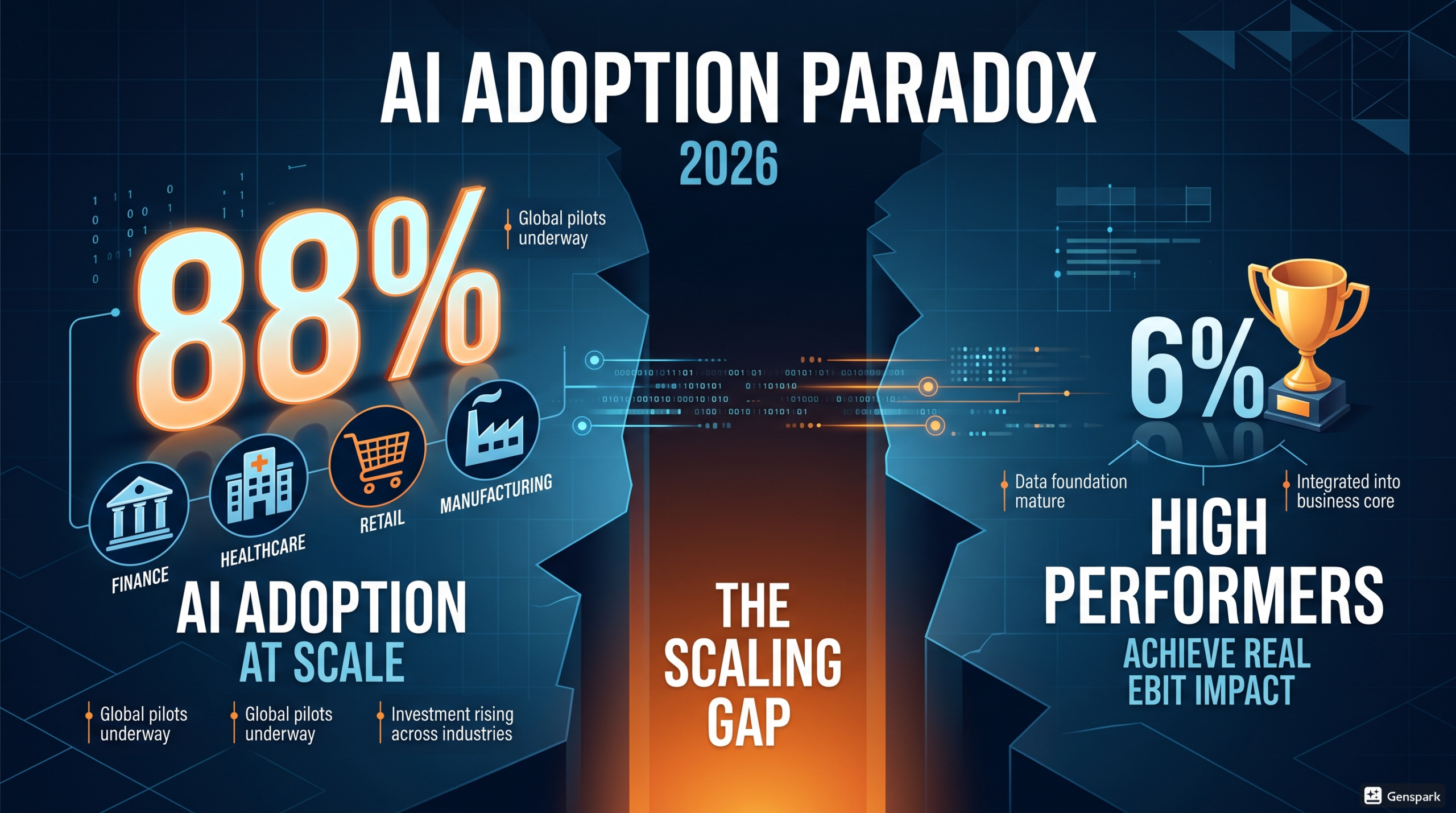
2Creating a successful AI-powered startup in 2026 requires deep niche expertise (not AI capability), engineering outcomes manually before building code, and owning end-to-end workflows—the founding edge is now “Service as Software” replacing expensive human agencies in hyper-specific vertical niches, since 85% of AI startups fail within 3 years and 95% of AI pilots fail to deliver measurable ROI.trustedlibraryyoutubevideohighlight
Executive Summary: The 2026 Reality Check
The AI startup landscape has undergone a paradigm shift. We’ve transitioned from “AI wrappers” (simple prompt layers on foundation models) to AI-native ecosystems where agentic AI drives operational execution. Success requires proprietary data moats, measurable economic outcomes, and workflow ownership—not just “cool demos”.wearepresta+2
Critical Reality Check
| Metric | 2026 Reality | Source |
|---|---|---|
| AI Startup Failure Rate (3 years) | 85% | videohighlight |
| AI Pilot Projects Without ROI | 95% | videohighlight+2 |
| Fast Revenue Acceleration Pilots | 5% | gloriumtech |
| AI Wasted ($40B, past 2 years) | $40 billion | videohighlight |
| Projects Abandoned | 42% (up from 17%) | videohighlight |
| AI Automation Market Size | $169.46 billion | statifacts+1 |
| AI-Native Conversion Rate | 56% trial-to-paid | gloriumtech |
| Time to AI MVP Launch | 10–20 weeks | gloriumtech |
Young Zhao’s insight (OpusClip CEO, $215M valuation): “The founding edge in 2026 is deep niche expertise, not AI capability—every competitor has the same models”.trustedlibrary
Phase 1: The First 30 Days – Validation Before Building
Step 1: Find Your Boring Vertical Niche (Week 1–2)
Ruthlessly segment until you cannot segment further:
| Example | Why It Fails | Why It Works |
|---|---|---|
| ❌ “Restaurant software” | Too broad | — |
| ❌ “Cantonese restaurant” | Still too broad | — |
| ✅ “Cantonese dim sum restaurants in San Francisco with 15–30 seats” | — | Specific niche trustedlibrary |
Key criteria:
- Boring markets → Non-boring markets are 10–100x more competitivetrustedlibrary
- Served by agencies/freelancers → That’s the “service-as-software” opportunitytrustedlibrary
- Hacky internal tools → You can replace them with end-to-end automationtrustedlibrary
- Existing workarounds → Humans, internal tools, cobbled solutionstrustedlibrary
What to avoid:
- Features inside existing workflows owned by incumbents (e.g., note-taker for Zoom = platform can ship in weeks)trustedlibrary
- Prompt wrappers around foundation models (next release makes you redundant)trustedlibrary
- Markets where you can’t own workflow end-to-endtrustedlibrary
Step 2: Engineer the Outcome Manually (Week 3)
Don’t write code yet. Manually engineer the final outcome and send it to potential customers to validate payment intent.youtubetrustedlibrary
The “Wizard of Oz” Strategy:
text┌─────────────────────────────────────────────────────────────────┐
│  1. Identify painful job to be done                             │
│  2. Manually complete the task for 3–5 potential customers     │
│  3. Email results to them                                       │
│  4. Ask: "What would you pay for this?"                        │
│  5. Look for signals: people asking for output, complaining    │
│     about queue limits, asking about pricing tiers              │
└─────────────────────────────────────────────────────────────────┘
Critical signals of product-market fit:
- ✅ Pricing inquiries (not just “this is amazing”)trustedlibrary
- ✅ Repeat usagetrustedlibrary
- ✅ Complaints about queue/limitstrustedlibrary
- ❌ Positive feedback alone = NOT signaltrustedlibrary
Young Zhao’s validation: “If you cannot describe your product’s value in 10 words, you probably haven’t found product-market fit”.trustedlibrary
Step 3: Build Discord Bot Before UI (Week 4)
Validate retention and engagement with minimal engineering investment.trustedlibrary
| Approach | Pros | Cons |
|---|---|---|
| Discord Bot | Fast, cheap, validates engagement | Limited to Discord users trustedlibrary |
| Simple Landing Page | Tests conversion | No retention data trustedlibrary |
| Full UI | Complete experience | Slow, expensive, hard to iterate trustedlibrary |
Why this works: You can build a proof-of-concept with a coding tool (e.g., Cursor) in a few days—no need for months of development.trustedlibrary
Phase 2: Building Your AI Product (Weeks 5–12)
Step 4: Build Proof-of-Concept (Days 1–5, Week 5)
Use coding tools like Cursor to build a few-day prototype.trustedlibrary
| Tool | Best For | Cost |
|---|---|---|
| Cursor AI | Code generation, debugging | Free–$20/month trustedlibrary |
| Abacus AI Deep Agent | Building full SaaS products | $10/month youtube |
| LangChain | AI workflow orchestration | Free gloriumtech |
| PyTorch | Model training | Free gloriumtech |
Typical AI MVP timeline: 10–20 weeks to functional MVP.gloriumtech
Step 5: Return to Early Users with Prototype (Week 6–7)
Ask not just “Do you like it?” but “What would you pay for this?”.trustedlibrary
| Validation Question | Critical Answer Required |
|---|---|
| Do you have relevant data? | Yes — mapped sources identified gloriumtech |
| Is AI approach technically viable? | Proof of feasibility tested gloriumtech |
| What business metric will improve? | % reduction, cost savings, revenue uplift gloriumtech |
| How measured at 30/90/180 days? | KPIs defined gloriumtech |
| What happens if AI is wrong? | Risk acceptable or human fallback gloriumtech |
| Can this be solved cheaper without AI? | If yes, don’t use AI gloriumtech |
| Who owns the AI outcome internally? | Named stakeholder gloriumtech |
Critical: Positive feedback alone is NOT signal. Pricing inquiries and repeat usage ARE signal.trustedlibrary
Step 6: Think About Proprietary Data Moat (Week 8–10)
Build for what comes after foundation models, not what exists now.trustedlibrary
| Data Strategy | Action Required |
|---|---|
| Inventory Sources | Internal databases, logs, sensors, external APIs gloriumtech |
| Assess Quality | Completeness, accuracy, bias checks gloriumtech |
| Labeling Workflows | 80% of AI project time = data preparation gloriumtech |
| Governance & Compliance | HIPAA (U.S.), GDPR/ISO 27001 (Europe) gloriumtech |
| Continuous Retrain | New data flows back into model pipeline gloriumtech |
Why this matters: “Think early about what proprietary data you can accumulate as the product and user base grow—this becomes your moat”.trustedlibrary
Step 7: Distribution Channel as Strategic Decision (Week 11–12)
Distribution is now a first-class strategic decision, not an afterthought.trustedlibrary
| Strategy | Action |
|---|---|
| Structured Capability Data | Clear, machine-readable specs of what AI can do, limitations, price-to-outcome ratio wearepresta |
| Proof of Performance (PoP) | Publicly available, audited data proving AI’s accuracy/reliability wearepresta |
| API-First GTM | Optimize pricing/documentation for “Agent-to-Agent” (A2A) economy wearepresta |
Key insight: Many “Users” will be other AI agents calling your API.wearepresta
Phase 3: Pricing Your AI Product (Weeks 13–16)
Step 8: Anchor Pricing to Value Replaced
Benchmark AI tool against human labor costs, not server costs.youtubetrustedlibrary
| Pricing Model | Best For | Example |
|---|---|---|
| Usage-based | Individual creators, variable needs | $0.10 per API call trustedlibrary |
| Seat-based | Enterprise teams, predictable usage | $50/user/month trustedlibrary |
| Hybrid | Balance revenue + customer needs | $100/month + $0.05 per call gloriumtech |
Critical: Factor in unit economics from day one—inference cost and storage costs can invert margins over time.trustedlibrary
Step 9: Run Pricing Experiments Early (Weeks 14–16)
Target 20–30 customer interviews per major pricing decision.trustedlibrary
| Strategy | Action |
|---|---|
| Stratify Sample | Vary industry, purchasing power, geography, use case trustedlibrary |
| Test Tiers | Basic ($29), Pro ($79), Enterprise ($299) trustedlibrary |
| Ask Directly | “What would you pay for this?” trustedlibrary |
| Say No to Rest | Optimize for target ICP, not everyone trustedlibrary |
You do not need a price that satisfies everyone—optimize for your target ICP and say no to the rest.trustedlibrary
Phase 4: Scaling Your AI Startup (Months 5–12)
Step 10: Achieve “Cumulative Intelligence” Moat
The ultimate goal: “Cumulative Value”—every time user interacts, product gets better for that specific user.gloriumtech
| Example | Evolution |
|---|---|
| AI-powered design tool | Initially: simple layouts → After 1 month: learned color palette, typography preferences, visual voice → Eventually: drafts entire brand identities matching user’s brain |
| Switching Cost | Becomes insurmountable. User would have to “re-train” new tool for months to reach same efficiency gloriumtech |
| Result | Move from vendor to strategic product partner gloriumtech |
This is the ultimate goal of finding product-market fit in 2026.wearepresta
Step 11: Manage Token Economy (Critical for Unit Economics)
Founders often underestimate the cost of high-volume inference. Sustainable AI product strategy must include “Token Efficiency”.gloriumtech
| Strategy | How It Works | Cost Reduction |
|---|---|---|
| Model Routing | Router classifies queries by difficulty. “Reset Password” → deterministic script (free). “Summarize Email” → cheap SLM ($0.10/1k). “Strategic Analysis” → Frontier Model ($10.00/1k) | 30–80% gloriumtech |
| Semantic Caching | Cache results of common queries. If User A asks “What is vacation policy?” and model answers, User B asking same gets cached answer instantly | Zero cost gloriumtech |
| Token Optimization | Aggressively optimize prompts to use fewer tokens. RAG systems retrieve only most relevant chunks, not whole documents | Smaller context window gloriumtech |
| Model Distillation | Take knowledge from large expensive model (GPT-o1) and train smaller SLM for specific routines | Up to 90% gloriumtech |
Critical insight: If cost-per-user is higher than customer lifetime value (LTV) due to inefficient token usage, growth will kill your runway. Treat “Tokens” as finite resource budgeted as strictly as marketing spend.gloriumtech
Phase 5: Go-To-Market & Growth (Months 6–12)
Step 12: Retention-Led Growth (RLG)
In AI Era: Cost of acquisition is high, but cost of “churn” is even higher because every lost user takes their “preference graph” with them.wearepresta
Achieve through: “Cumulative Intelligence” moat—making product so deeply integrated into user’s unique workflow that leaving becomes logical and economic impossibility.wearepresta
Step 13: Ethical Triage as Competitive Advantage
By 2026, AI ethics has moved from “philosophy” to “compliance requirement”.wearepresta
| Ethical Component | Action Required |
|---|---|
| Transparency by Design | “Reasoning Transparency”—if AI denies loan, user clicks button to see exact “Reasoning Chain” wearepresta |
| Bias Mitigation | Rigorous “Data Hygiene” process—training datasets constantly audited for demographic/professional skews wearepresta |
| Bias Bounty Programs | Incentivize users/researchers to find and report edge-case biases in models wearepresta |
| Deterministic Fallbacks | Critical decisions (medical/legal): human-in-the-loop requirement if confidence low wearepresta |
| Data Sovereignty | Allow users/organizations to “own” fine-tuning of interactions wearepresta |
Treat ethics as “Core Feature” to build brand resilient to “tech-backlash” that follows rapid innovation.wearepresta
Real Case Study: Young Zhao & OpusClip ($215M AI Startup)
The Success Story
Yang (Young) Zhao, co-founder and CEO of OpusClip:
- 50 million users
- $215 million valuation
- 2.5 years from inceptionyoutubeulistenyoutubetrustedlibrary
What he did:
| Strategy | Action |
|---|---|
| 30-Day Launch Plan | Do NOT write code in first month youtube |
| “Wizard of Oz” Validation | Manually engineer results, email to users to validate payment intent youtube |
| Product-Market Fit Signal | Usage-based retention + complaints about quotas/queues youtubeulisten |
| Pivot Story | From unpopular livestreaming tool → breakout AI clipping product by doubling down on feature users loved youtubeulisten |
| Service as Software | Find boring, hyper-specific niches; replace expensive human agencies with autonomous agents youtube |
Key insight: Young warns that “easy” days of AI wrappers are over. Avoid building simple features that incumbents like Zoom or Google can replicate in a week.youtube
Critical Analysis: Positive vs. Negative Impacts
✅ Positive Contributions to Society & Work
| Sector | AI Value Addition | Real-World Impact |
|---|---|---|
| Healthcare | Process efficiency (64%) + productivity (59%) spglobal | AI agents analyze patient data for hyper-personalization pwc |
| Financial Services | Demand sensing, forecasting, anomaly detection pwc | Resume optimization for finance professionals developersmatrix |
| Education | Scalable worksheet/lesson plan creation | Teacher earns $3K/month with 4 hrs/week developersmatrix |
| Retail/E-commerce | Customer data analysis for personalized pricing pwc | Marketing at 50% traditional agency cost developersmatrix |
| Small Businesses | Extend capacity without hiring specialists spglobal | SMEs forecast +3% net employment from AI spglobal |
| Global GDP | Productivity boost + capital accumulation imf | AI can lift global growth by accelerating R&D imf+1 |
Key statistic: 59% of enterprises prioritize employee productivity through AI, not headcount reduction.spglobal
❌ Negative Impacts & Critical Risks
| Risk Category | Severity | Evidence & Impact |
|---|---|---|
| Startup Failure Rate | Critical | 85% of AI startups fail within 3 years videohighlight |
| Pilot ROI Failure | Critical | 95% of AI pilots fail to deliver measurable P&L impact videohighlight+2 |
| Fast Revenue Acceleration | Critical | Only 5% of AI pilots achieve rapid revenue acceleration gloriumtech |
| Job Displacement | High | S&P Global PMI: AI has net negative employment impact (-5 points) in 2026 spglobal |
| Large Enterprise Impact | Very High | Large firms: -13 points net employment forecast for 2026 spglobal |
| Mid-tier Collapse | Medium-High | AI agents replace entry-level + mid-level work; workforce becomes hourglass pwc |
| $40B Wasted | High | Failed AI initiatives over past 2 years videohighlight |
| Poor Unit Economics | High | AI writing tool: $50–$75 cost/customer vs. $29 charge = -$19 to -$40 loss/month videohighlight |
| API Dependency Risk | High | If reliant on OpenAI APIs, companies risk collapse when competitors emerge or terms change videohighlight |
Critical failure from S&P Global: “A lot of companies are now utilizing AI where they would have recruited a young person… We’ll see in a few years’ time quite a big employment gap where we’ll lose those skills because enterprise businesses have gone down the AI route”.spglobal
Typical AI Development Mistakes in 2026
| Mistake | Consequence |
|---|---|
| Over-engineering | Too much complexity makes it hard to change; drains bank account gloriumtech |
| Building before validating | If nobody wants product, tech doesn’t matter. Teams spend months on model nobody used gloriumtech |
| Ignoring data governance | GDPR/HIPAA are strict. Massive fines if ignored. Security is requirement gloriumtech |
| Chasing model size instead of value | Bigger model not always better. Small, fast model often more useful gloriumtech |
| Treating AI as magic | It’s just math and code. It makes mistakes. Promise perfection = fail gloriumtech |
| Being “AGI-pilled” | Assume foundation models will do current job at 99–100% in next few releases trustedlibrary |
Remember: Chasing AI innovation just for the sake of it is the worst business goal.gloriumtech
Your 30-Day AI Startup Framework
Week 1–2: Deeply Understand One Specific Vertical
- Existing workflow, pain points, alternative solutions, precise ICPtrustedlibrary
- Interview 30+ potential customerstrustedlibrary
- Define success metrics (KPIs)trustedlibrary
Days 1–14: Market research, user interviews, niche definitiontrustedlibrary
Week 3: Engineer Outcome Manually
- Manually complete task for 3–5 customerstrustedlibrary
- Email results to themtrustedlibrary
- Ask: “What would you pay for this?”trustedlibrary
Days 15–21: “Wizard of Oz” validationtrustedlibrary
Week 3–4: Build Proof-of-Concept
- Use Cursor or similar coding tooltrustedlibrary
- A few days is enough for prototypetrustedlibrary
- Return to early users with prototypetrustedlibrary
Days 22–30: Prototype, user feedback, pricing inquiriestrustedlibrary
Action Checklist: Start Your AI Startup Today
text□ Week 1: RIDRUTHLESS NICHE SEGMENTATION
  • Identify boring vertical (specific tier within specific cuisine/type)
  • Avoid "restaurant" → prefer "Cantonese dim sum restaurants in SF with 15–30 seats"

□ Week 2: USER INTERVIEWS
  • Interview 30+ potential customers
  • Define existing workflow, pain points, alternatives
  • Describe product value in 10 words

□ Week 3: WIZARD OF OZ VALIDATION
  • Manually engineer outcome for 3–5 customers
  • Email results to them
  • Ask pricing questions
  • Look for signals: queue complaints, pricing inquiries, repeat usage

□ Week 4: PROOF-OF-CONCEPT
  • Build prototype with Cursor/Abacus AI (few days)
  • Return to early users
  • Ask: "What would you pay for this?"
  • Think about proprietary data moat

□ Month 2: PRICING EXPERIMENTS
  • Target 20–30 customer interviews
  • Stratify sample (industry, purchasing power, geography)
  • Test usage-based vs. seat-based pricing
  • Optimize for target ICP, say no to rest

□ Month 3: BUILD MVP
  • 10–20 weeks to functional MVP
  • Cost: $25K–$50K for functional MVP
  • Implement model routing, semantic caching
  • Manage token economy

□ Month 6: SCALE TO $10K+/MONTH
  • Achieve 5–10 paying customers
  • Systematize delivery
  • Build cumulative intelligence moat
  • Retention-led growth
Final Word: The Real Value Proposition
AI’s true contribution to society is democratizing capability—enabling solopreneurs with domain expertise to package knowledge into scalable products without hiring designers, developers, or editors. The bottleneck is no longer technical execution; it’s choosing the right opportunity and building a sustainable system.developersmatrix
Remember: AI is a multiplier, not a creator. It multiplies your existing expertise, taste, and judgment—it does not replace them. The highest earners aren’t those who know the most prompts; they’re those with deep domain knowledge using AI to scale application.developersmatrix
Critical reality check: Most people start three things, get distracted, and quit before reaching the inflection point. The real edge is picking one, staying with it through slow early months, and iterating.